Imagine dedicating your entire life to one moment the FIFA World Cup only to discover that qualifying for the tournament may not guarantee you entry into the host country.That is the surreal reality facing the Iranian national football team.
With fewer than 100 days before the start of the 2026 FIFA World Cup across the United States, Canada, and Mexico, Iran’s players are preparing for football’s biggest stage while simultaneously living through a diplomatic nightmare. The team has qualified. The fixtures are scheduled. The fans are ready.
Yet uncertainty still hangs over whether players, officials, journalists, and supporters will be allowed to travel freely to the tournament. A Farewell Filled With Pride and Anxiety
In Tehran’s Enqelab Square, thousands of supporters recently gathered to send off Team Melli in an emotional public farewell ceremony. Flags waved. Fans chanted, The new World Cup kit was unveiled, Players delivered patriotic speeches. But beneath the excitement sat a painful uncertainty.
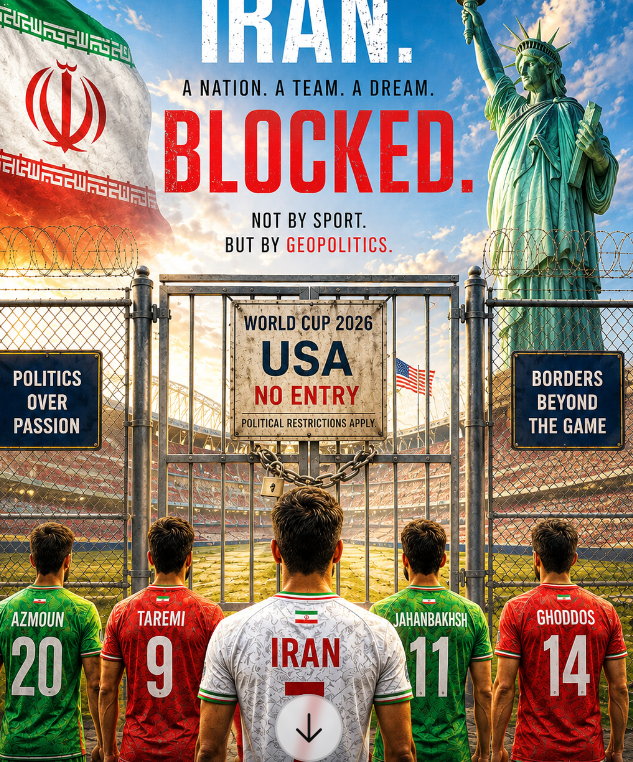
Iran’s Football Federation president Mehdi Taj admitted that players were still awaiting visa approvals for the United States.
That single issue has transformed what should have been a straightforward sporting journey into an international political controversy.
Football Meets Geopolitics
The 2026 World Cup was supposed to symbolize global unity. Instead, Iran’s participation has become tangled in escalating tensions between Tehran and Washington, intensified by military confrontations earlier this year involving the United States, Israel, and Iran.
The situation became even more complicated after Mehdi Taj himself was denied entry into Canada for the FIFA Congress due to alleged links to Iran’s Revolutionary Guard Corps, which both Canada and the United States classify as a terrorist organization. Suddenly, football was no longer just football.
Iran requested that its group-stage matches be moved from the United States to Mexico because of security and visa concerns. FIFA rejected the request and insisted the schedule would remain unchanged.
Now the Iranian squad is training in Turkey while visa processing continues in diplomatic limbo.
FIFA’s Greatest Contradiction
FIFA’s slogan has long been: “Football Unites the World.” But the Iran situation exposes the limits of that ideal. What happens when the host country and a participating nation are geopolitical enemies?
What happens when immigration policy collides with sporting qualification?
What happens when players become trapped between diplomacy and dreams?
Technically, FIFA can organize the tournament. But it cannot fully control borders, visa systems, or geopolitical hostility.That contradiction is now impossible to ignore.
The governing body insists it remains confident Iran will participate after “positive talks” with Iranian officials in Istanbul. Yet confidence and certainty are not the same thing.
The Human Cost
Lost beneath the politics are the players themselves. Many of these athletes have spent decades chasing the World Cup dream. Some grew up in modest neighborhoods playing football in dusty streets.
Others endured sanctions, economic hardship, travel restrictions, and political pressure throughout their careers. Now, after finally qualifying for the biggest tournament on Earth, they face questions no footballer should have to answer:
Will they be welcomed?
Will their families get visas?
Will fans be allowed into stadiums?
Will politics overshadow every match?
Even supporters are caught in the uncertainty. Reports suggest many Iranian fans fear visa denials or enhanced scrutiny while attempting to enter the United States.
For ordinary Iranians, football has always been more than sport. It is one of the few national spaces where political divisions briefly dissolve into collective emotion. That is why the farewell rally mattered so deeply.
It was not just a sendoff.
It was a declaration:
“We qualified. We belong there.”
A Tournament Overshadowed by Politics
Iran’s crisis may become one of the defining stories of the 2026 World Cup. Not because of tactics or goals, but because it forces the world to confront an uncomfortable reality: globalization in sport works smoothly only when politics allows it.
The modern World Cup depends on open borders, diplomatic cooperation, international mobility, and institutional trust. When those foundations crack, the entire idea of a “global tournament” becomes fragile. And that is the tragedy facing Team Melli today.They earned their place on the pitch. Now they must wait to see whether geopolitics will let them step onto it.