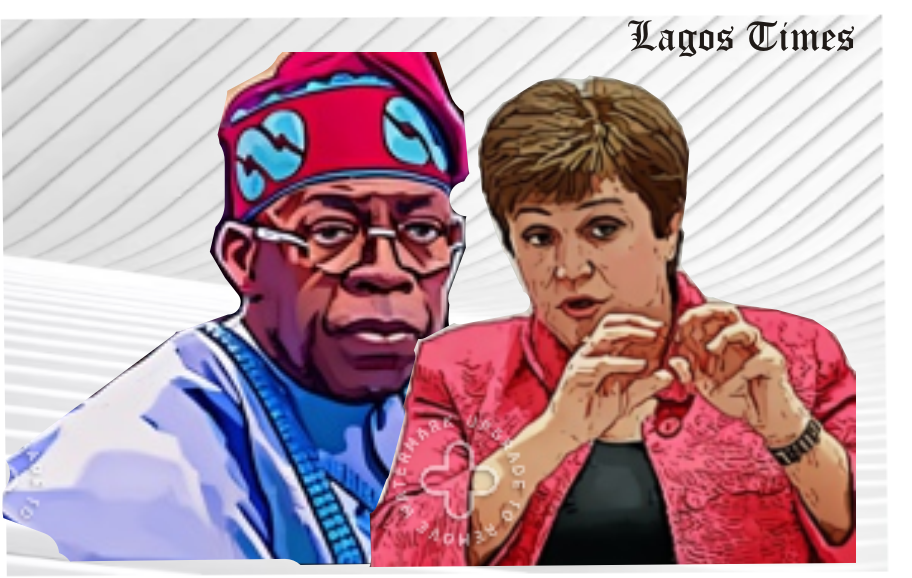
Analyzing the developments in Tinubu’s administration one can’t help but notice how IMF throws policy and ideas to Nigerian President Tinubu. The president seem to assimilate and implement their ideas without batting an eyelid. It is understandable that Nigeria is among IMF member countries, but there is an urgent need to set boundaries and make decisions based on indigenous factors and differences.
The International Monetary Fund (IMF) is an international organization which works to achieve sustainable growth and prosperity for all of its 191 member countries. It does so by supporting economic policies that promote financial stability and monetary cooperation, which are essential to increase productivity, job creation, and economic well-being. The IMF is governed by and is accountable to its member countries.
Tinubu’s adherence to IMF’s Fuel Subsidy removal
IMF has consistently thrown around some policies which Nigerian president doesn’t hesitate to implement. One of such controversial policies is removal of Fuel subsidy, Inflation has gone sky-high and with it prices of food, energy, medicine, and other essentials,”. Tinubu should form the habit of consulting well studied indigenous economists before adhering to IMF ideas and decisions.
We need to redefine governance models in Africa and some third world countries “We must not accept all the recommendations of the World Bank and IMF, most of them are wrong.
We must use home grown policies to solve our economic problems, because the majority of our problems are caused by local issues. For instance Deep sited corruption is one of the problems hindering economic growth. The amount of looted fund recorded these recent years, if well channeled in proper places would have propelled Nigeria into enviable heights but this must be addressed if any economic reform will make headway.
Tribalism which is also Nigeria’s obvious deep sited problem must be solved with indigenous agreement and solutions.
IMF once suggested this subsidy removal to previous Nigerian Presidents, they never implemented it, perhaps they saw this as life threatening to Nigerian citizens. which won’t create greater impact on the long run.
IMF had been suggesting to Previous Nigerian presidents to unify all segments of foreign exchange market , they never adhered to it, from Fmr President Olusegun Obasanj to Fmr President Muhammadu Buhari . It appears President Tinubu sees IMF as life savers, people he should rely on. President Tinubu needs to refresh his mind on the reason for Colonialism in the first place. Colonialism never died, The dictionary put it this way the policy or practice of acquiring full or partial political control over another country, occupying it with settlers, and exploiting it economically. Subtle means of colonialism is still practiced in this modern era, IMF might be exploiting Nigeria economically using President Tinubu, may be at the end of the day Nigerian Govt is left with no option other than collecting more loans from IMF.
We will try to analyze these few IMF policies which President Tinubu obeyed judiciously.
Adherence to Unification of Foreign Exchange:
Not long after President Tinubu’s ascension to power. Central Bank of Nigeria (CBN) announced the unification of all segments of the foreign exchange (FX) market, President Bola Tinubu became their puppets, he started criticizing the country’s central bank in his inaugural speech on 29 May, saying that monetary policy requires a “thorough house-cleaning”. And indeed on 14 June came the replacement of the old regime of multiple exchange rate “windows” for different purposes with, in effect, a market rate. The naira immediately fell 36% against the dollar on the official market. Analysts said they expected this move from Tinubu when, on 9 June, he suspended Godwin Emefiele as governor of the CBN.
Folashodun Shonubi, a deputy governor in charge of operations at the Apex bank took over, in an acting capacity. Emefiele was also detained by police “for investigative reasons”. The president “clearly signaled that he will be hands-on in steering the CBN’s monetary policy thrust, Emefiele’s suspension puts the final nail in the coffin of monetary policy independence.
The multiple exchange rates have been blamed for keeping the naira artificially strong. Some investors hailed President Tinubu for his aggressive moves, seeing them as signals that he is keen on resetting the country’s economy on an orthodox path. Tinubu’s team knew then they don’t have a honeymoon period from a governance standpoint – which means, painful economic reforms awaits early in his tenure,” The liberalisation of the market signalled the removal of some of the restrictions on the foreign exchange rate in the official market.
“The devaluation and unification brought to an end the multiple foreign exchange markets and rates. But since the unification of foreign exchange, how has Nigeria fared?Nigeria has been struggling to attract foreign direct investment (FDI) in the last few years, with investment falling by as much as 90% since 2008. A severe dollar shortage has seen companies flee the continent’s biggest economy as investment fell to $468m in 2022 from $698m a year earlier, according to data from the National Bureau of Statistics, where does this leave the job market? Unemployment will not be tackled with this measure.
Emirates Airlines halted flights to the country due to dollar shortages and restrictions on repatriating funds. “FX challenges are top of mind for multinational companies bringing FDI into Nigeria. Their inability to repatriate earnings in full has kept FDI below its potential, with inflows to smaller neighbors like Ghana outpacing Nigeria’s in recent years.
Why would President Tinubu agree to the measures that will spike Nigerian’s Inflation rate?. Apex banks of developed countries find it difficult to reduce inflation even to degree of 1%, but President Tinubu spikes his inflation rate carelessly with no measures on ground to reduce it.
Fresh Round of IMF Borrowing Imminent
Still, it’s not clear whether President Tinubu’s fiscal policy is moving in a more sustainable direction. Admittedly, the removal of fuel subsidies, which last year amounted to more than 2% of GDP, creates a big fiscal saving. But it looks most likely that the resources will be spent rather than saved after the president pledged that the funds will be channelled into ‘public infrastructure, education, health care and jobs’.
That reinforces our view that the debt-to-GDP ratio will continue to rise, leaving open the possibility of fresh round of borrowing from IMF. One can conclude that IMF is spinning president Tinubu for their own benefit. No one has seen any significant improvement in health care, education and infrastructure, Unemployement still at very high level. It just seem Nigerians faced excruciating pains for nothing.
IMF Reactions after Policy Implementation.
IMF confirmed that Nigeria has fully repaid the $3.4 billion COVID-19 financial support it got under the Rapid Financing Instrument (RFI).
But despite the confirmation, the government is still indebted to the multilateral organisation to the tune of about $30m, which is the Special Drawing Rights (SDR) charges. The $30m equivalent of N48.2bn would be paid annually over a period of four years as charges on the loan. This would amount to over N190bn. Nigeria should desist from IMF loans that incur terrible charges, the fragile economy cannot struggle to pay debts and still struggle to pay off charges which might have been avoided in the first place, so IMF have been spinning Nigeria with reforms that will bring them back to depend and borrow loans from them. I mean N190bn is a staggering sum and earnings for IMF.
In Nov 2024, the same IMF Blasted Tiinubu , saying the reforms in Nigeria are not working, poverty still very high. They further acknowledged few countries that have recorded little success in reforms but Nigeria was not mentioned, rather it mentioned Nigeria amongst those failing to meet desired results. This boils down to the earlier statement that some of Nigerian’s problems are indigenous in nature, Nigeria shouldn’t struggle to record success when compared to other countries because, they have abundant resources and human resources as well to become high fliers
Conclusion
There is need for Nigeria to toe the line of Asian tigers (Korea, Taiwan, Singapore, and Hong Kong) who ignored the IMF and World Bank economic packages but yet have continued to record progress in their economies.
“The Asian Tigers jettisoned the IMF and World Bank but today we can see how they have progressed..
There should be a shift in Nigeria’s economic strategy via regional competition (Regional government) as a key driver for growth. Over dependence on Federal government is no longer feasible.
There should be commitment and cooperation of both the Government and the people, There are seasoned indigenous researchers in Nigeria which the president can work with, these are People who have studied the political and economic structure of Nigeria and be ready to present verified facts, not guess work. We cannot be successful and develop without putting in the work on both the side of the Government and the people, as Nigeria is today.