By Engr Chiamaka Nnadigwe
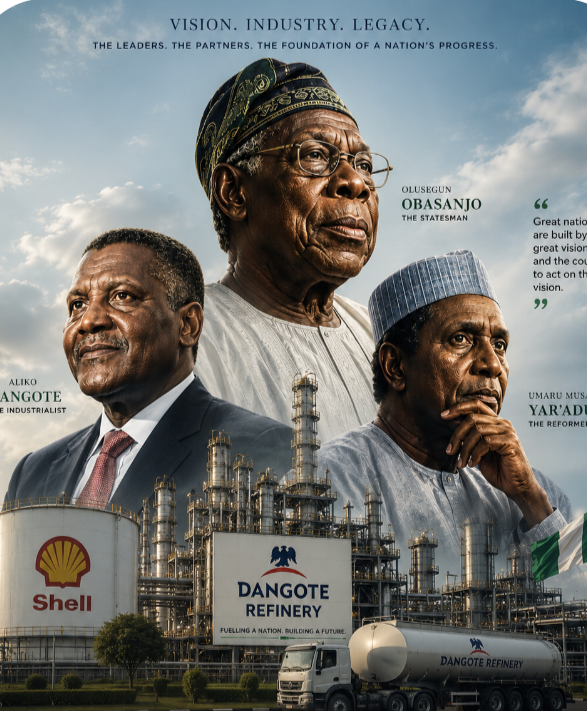
In a striking reflection on Nigeria’s long-running refinery crisis, former president Olusegun Obasanjo revealed that the country once stood at the edge of a transformative deal one that could have handed its struggling refineries to private operators like Aliko Dangote.
But that moment slipped away. What followed, according to Obasanjo, was a cascade of missed opportunities, political reversals, and a sobering admission: Nigeria’s refineries had deteriorated to near-scrap value.
The Deal That Almost Happened
Toward the end of his administration in 2007, Obasanjo pushed for the privatization of Nigeria’s state-owned refineries. The plan was simple in theory but bold in implication: transfer control to capable private investors who could fix what government had failed to maintain.
At the center of this effort was Dangote, already emerging as a dominant industrial force. A deal was reportedly close one that could have seen the refineries handed over for rehabilitation and operation under a private-sector model.
But when Umaru Musa Yar’Adua assumed office, the transaction was halted and ultimately reversed. The refineries remained under government control. That decision would prove consequential.
Shell’s Refusal: A Vote of No Confidence
Obasanjo didn’t stop with Dangote. In a revealing twist, he disclosed that he approached Shell plc to take over the refineries under a Public-Private Partnership (PPP) arrangement.
Shell declined.
Their reasons cut to the heart of Nigeria’s structural problems:
The downstream sector (refining and fuel sales) offered limited profitability compared to upstream (oil exploration and production).
a. The operating environment was weighed down by corruption and inefficiency
b. The risks outweighed the potential returns. This was not just a business decision—it was a blunt assessment of Nigeria’s governance climate.
Close to Scrap”: The Cost of Delay
Perhaps the most damning part of Obasanjo’s account is his assertion that the refineries had already deteriorated significantly, even back then.
Years of Poor maintenance, Political interference, Chronic underinvestment had reduced strategic national assets into liabilities. Today, facilities like: Port Harcourt Refinery, Warri Refinery, Kaduna Refinery have consumed billions in turnaround maintenance with little to show in consistent output.
Obasanjo’s implication is clear: by the time privatization became politically contentious, the assets themselves had already lost much of their value.
Dangote’s Revenge: Building What Government Couldn’t
History, however, has a sense of irony. Denied the opportunity to acquire state refineries, Aliko Dangote chose a different path—building his own.
The Dangote Refinery in Lagos is now: One of the largest single-train refineries in the world, Designed to meet Nigeria’s domestic fuel needs, Positioned to export refined products globally. What government couldn’t fix, private capital simply rebuilt from scratch.
The Bigger Question: Reform vs Politics: The failed refinery privatization underscores a deeper Nigerian dilemma, economic logic often collides with political sentiment. Opposition to selling national assets typically rests on: Fear of monopoly, Concerns about transparency, Nationalistic resistance to privatization but the alternative continued state control has historically produced inefficiency and decay.
The Yar’Adua administration’s reversal reflected these tensions, prioritizing public skepticism over market-driven reform.
PPP in Nigeria: Trust Deficit Remains the Core Issue
Obasanjo’s experience with Shell highlights a recurring challenge in Nigeria’s PPP ambitions: It’s not the lack of investors, it’s the lack of trust. For private firms, key concerns include: Policy inconsistency, Regulatory unpredictability, Corruption risks, Weak contract enforcement until these are addressed, even the most strategic assets may struggle to attract credible operators.
Final Analysis: A Lesson Still Unlearned
Obasanjo’s reflections are more than historical commentary—they are a warning.
Nigeria once had a chance to: Privatize failing refineries early, Attract experienced operators, Avoid decades of inefficiency, Instead, hesitation and reversal led to deeper decay.
Today, as the country embraces new PPPs, from airports to energy infrastructure—the same fundamental question remains:
Will Nigeria finally align policy with execution, or continue to lose opportunities at the intersection of politics and economics? Because the refinery story shows one thing clearly: sometimes, the real cost of inaction is not just failure, it is watching others succeed where you refused to act.